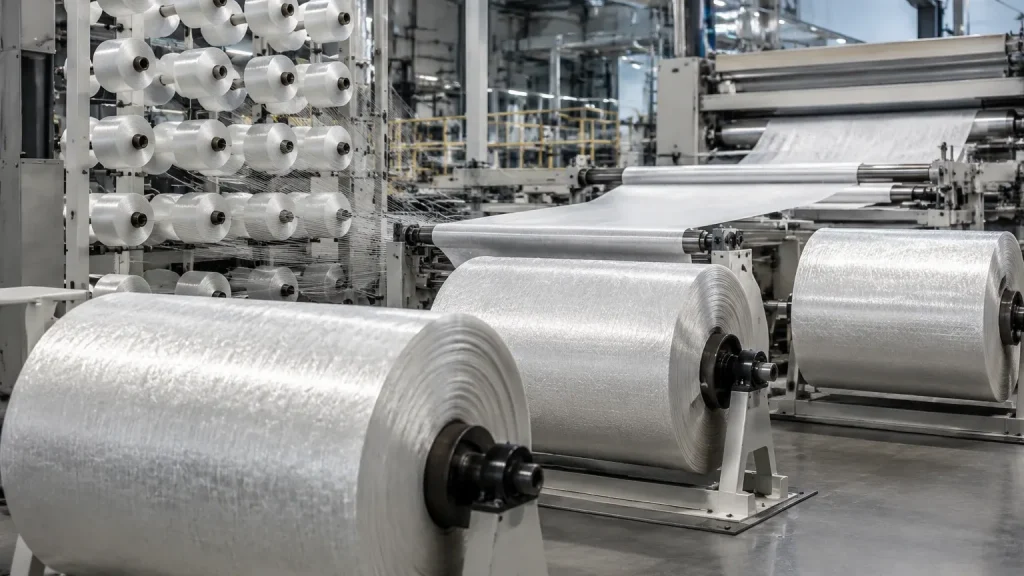
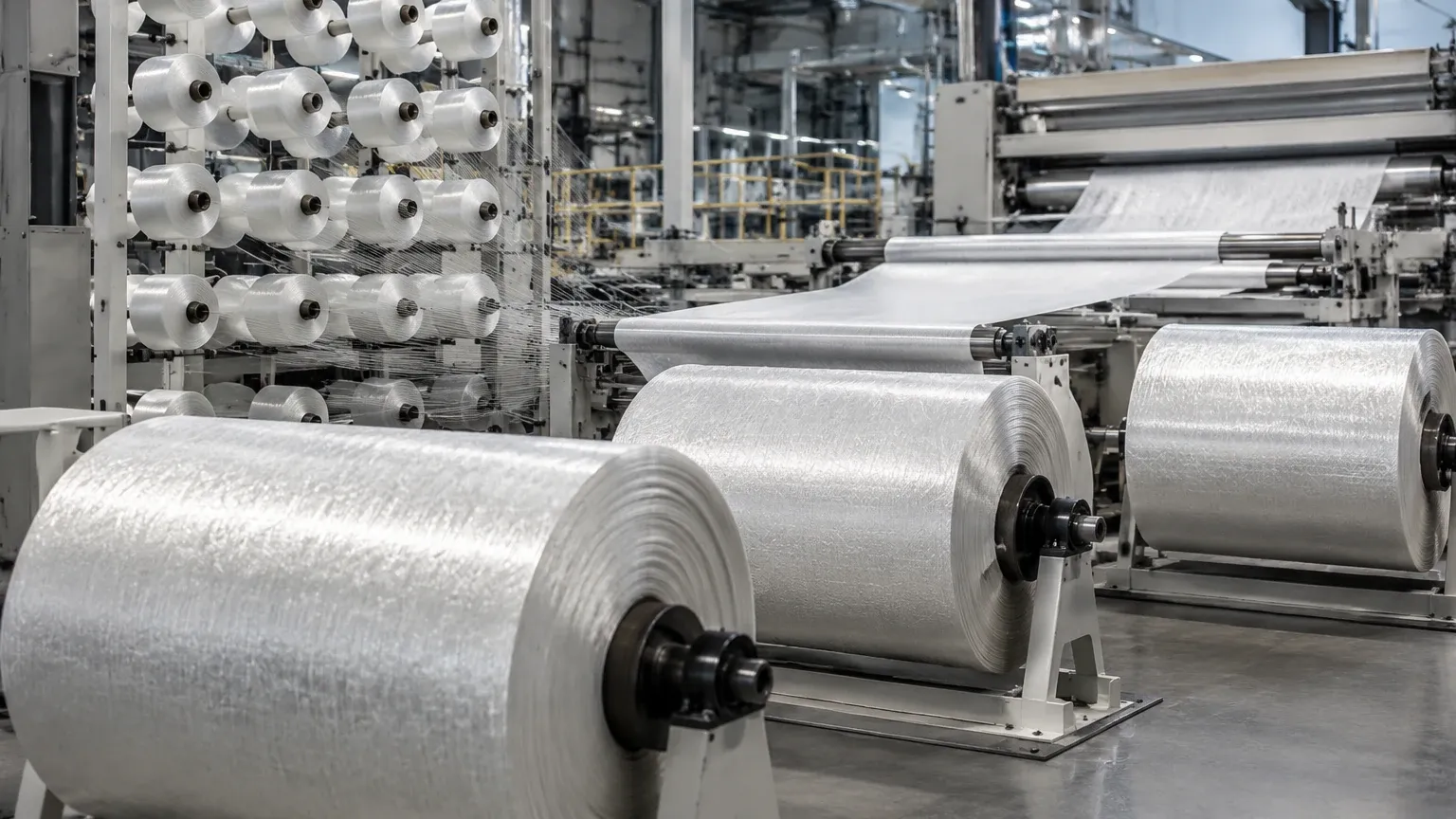
Direct & Assembled Roving for Composite Manufacturing
Reliable composite production starts with reinforcement that matches the resin, equipment and finished product. Direct roving and assembled roving are two important forms of continuous glass-fiber reinforcement. Choosing between them requires more than comparing tex values: strand construction, sizing chemistry and processing behavior all matter.
What is direct roving?
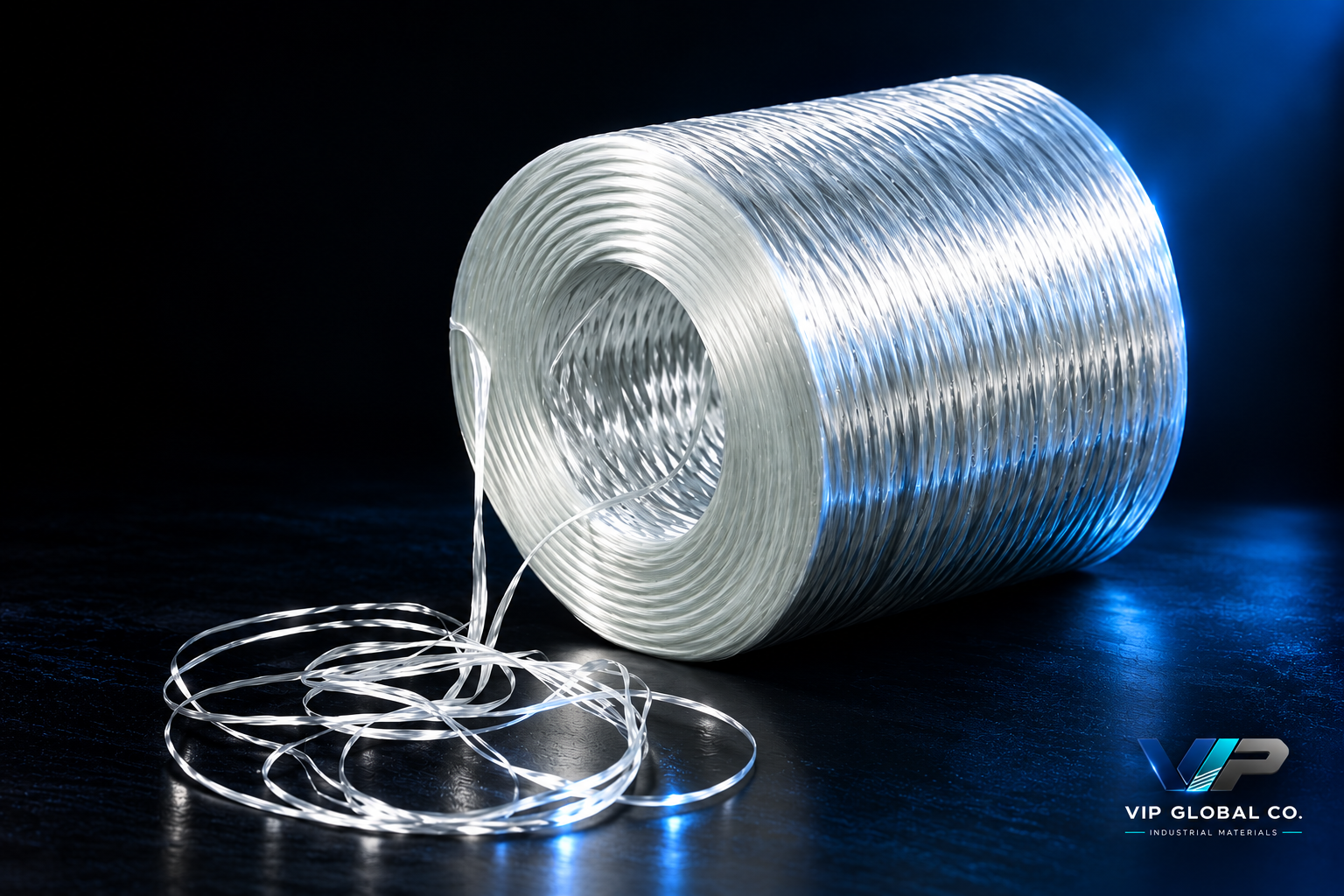
Direct roving, also known as single-end roving, consists of continuous glass filaments gathered into one strand during fiber manufacture and wound without intentional twist. Application-specific grades are used in filament winding, pultrusion and the manufacture of woven or stitched reinforcement fabrics.
In filament winding, continuous fibers are placed around a mandrel according to a defined reinforcement pattern. In pultrusion, reinforcement is pulled through resin impregnation and a forming die to produce continuous profiles. In both cases, consistent unwinding, controlled tension and effective impregnation support stable production.
What is assembled roving?
Assembled roving, also called multi-end roving, combines several strands into one package. Its construction and surface treatment are selected for the intended process. Depending on the grade, applications include spray-up, sheet molding compound (SMC), panel manufacture and chopping during GRP pipe production. Dedicated grades also exist for continuous filament winding.
Assembled roving is supplied as continuous reinforcement; it is not the same product as pre-cut chopped strands. When used in a chopping process, the equipment cuts the roving to the required length during manufacture. A grade intended for chopping should not automatically be substituted for a winding grade, even if both have the same tex.
Understanding Tex: 300, 600, 1200, 2400 and 4800
Tex expresses linear density: one tex equals one gram per 1,000 meters. A nominal 2400 tex roving therefore has a mass of 2.4 kilograms per 1,000 meters, excluding packaging. Tex does not describe filament diameter, resin compatibility or the strength of a finished laminate.
| Nominal tex | Nominal mass per 1,000 m |
|---|---|
| 300 | 0.30 kg |
| 600 | 0.60 kg |
| 1200 | 1.20 kg |
| 2400 | 2.40 kg |
| 4800 | 4.80 kg |
These values occur across commercial roving ranges, but every value is not available in every grade or in both roving constructions. Lower tex means less reinforcement mass per unit length; higher tex means more. The appropriate choice depends on the required fiber delivery, strand placement, equipment configuration and impregnation conditions. A higher tex is not, by itself, a higher-quality product.
Matching Roving to the Resin System
Sizing is the surface treatment applied to glass filaments to support handling and interaction with the resin. Grades are formulated for particular resin systems and processes. Suitable products are available for unsaturated polyester, vinyl ester, epoxy and selected thermoplastic systems, but compatibility must be confirmed for the individual grade.
Changing the resin while keeping the same tex can require a different reinforcement grade. For example, a 2400 tex roving selected for polyester-based pipe manufacture should not be assumed suitable for an epoxy system without reviewing its technical data.
Selecting Reinforcement for GRP Pipes and Tanks
Pipe and tank production may combine continuous reinforcement with chopped fibers. Continuous reinforcement supports the designed load-bearing directions, while chopped reinforcement can serve other functions within the laminate. The selection and proportion of each must follow the product design and manufacturing method.
For a winding operation, consider strand integrity, tension stability and resin impregnation. For in-line chopping, consider cutting consistency, dispersion, static behavior and compatibility with the resin. Two 2400 tex rovings may behave differently because their sizing and strand construction are different.
What to Evaluate During a Production Trial
- Stable package unwinding at the intended operating speed.
- Fuzz generation and buildup around guides or cutting equipment.
- Resin wet-out and the presence of dry fibers or trapped air.
- Cutting and dispersion behavior where chopping is required.
- Finished laminate quality and the tests required by the product specification.
Comparisons should use documented settings and representative production conditions. Where a supplier or grade changes, a controlled trial helps establish whether equipment adjustments or further qualification are needed. Product claims should be assessed against the actual technical datasheet and finished-part requirements.
Handling, storage and documentation
Keep packages protected from moisture and contamination and follow the manufacturer’s storage and handling instructions. Retain package labels and batch identification for traceability. Storage limits, conditioning requirements and packaging formats vary by product and should be confirmed before ordering.
Supply Through VIP Global Co.
VIP Global Co. maintains substantial warehouse stocks of direct and assembled roving, supported by an ongoing flow of incoming shipments. This combination of stocked material and cargo in transit enables us to supply customers across different destinations and coordinate deliveries according to their requirements. Available grades, tex values, quantities and dispatch schedules are confirmed at the time of inquiry.
VIP Global Co. can arrange sourcing of direct and assembled roving through its commercial partner network. Our approach is to match the requested reinforcement to the customer’s production requirements rather than select by tex alone. Requested specifications may include 300, 600, 1200, 2400 and 4800 tex, subject to the chosen grade and supplier availability.
For a quotation, please provide the roving type, nominal tex, resin system, manufacturing process, end application, required quantity and delivery destination. If available, include the technical datasheet or specification of your current product. For assembled roving used in GRP pipe production, specify whether the material will be chopped or used continuously.
Grade availability, packaging, lead time and delivery terms are confirmed for each inquiry. Any proposed alternative should be reviewed against the required technical specification and, where appropriate, validated through a production trial.