GRP Pipes: Technical Specifications and Selection Guide
Glass-reinforced plastic (GRP) pipes combine glass-fibre reinforcement with a thermosetting resin matrix. They are used in water transmission, irrigation, drainage, sewerage and industrial fluid systems. Their suitability depends on the complete pipe system: laminate, internal liner, joints, seals and installation conditions.
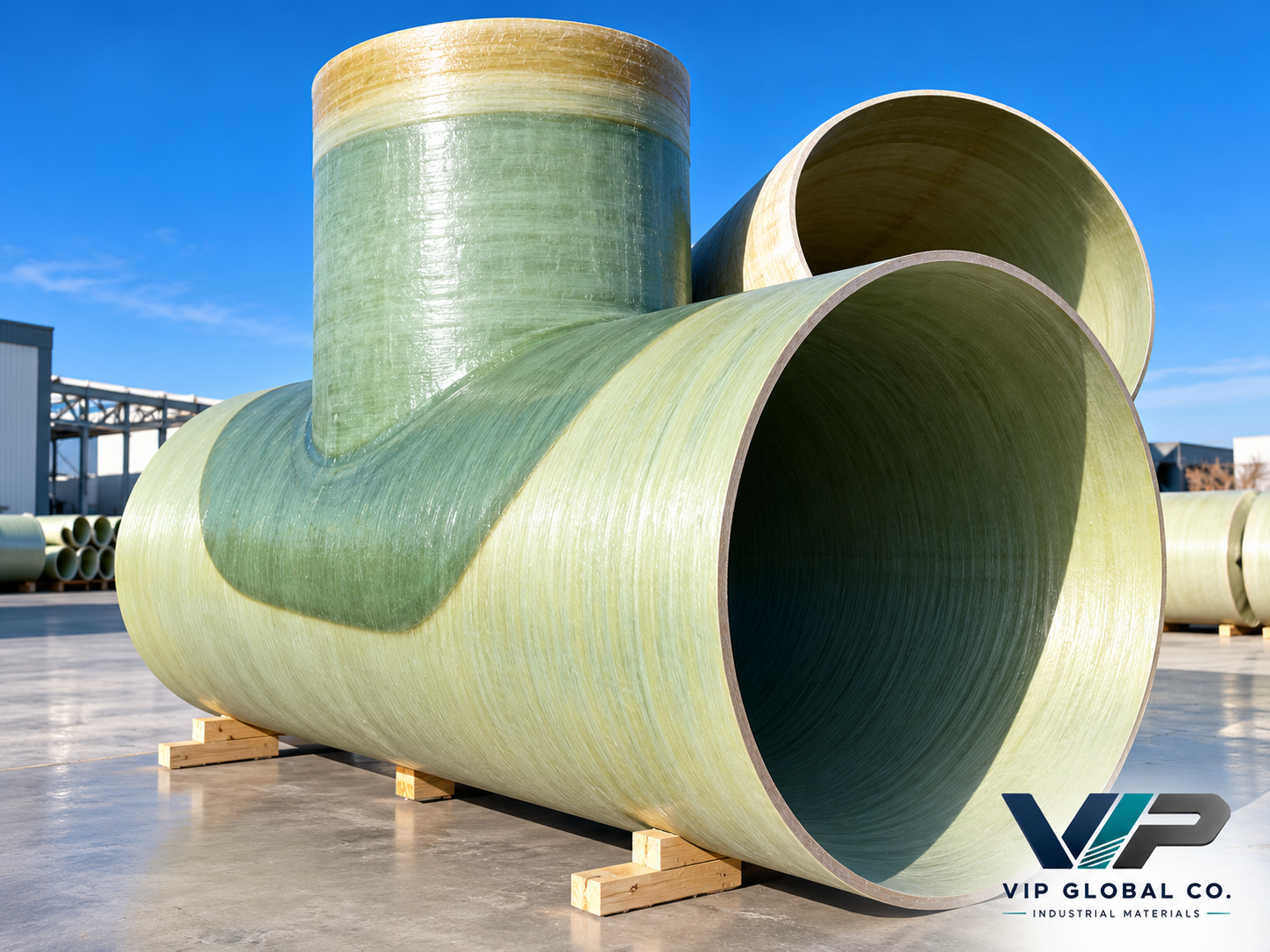
Glass-reinforced plastic (GRP) pipes combine glass-fibre reinforcement with a thermosetting resin matrix. They are used in water transmission, irrigation, drainage, sewerage and industrial fluid systems. Their suitability depends on the complete pipe system: laminate, internal liner, joints, seals and installation conditions.
Key Parameters for Pipe Selection
| Parameter | Technical meaning | Selection guidance |
|---|---|---|
| Nominal diameter — DN | Size designation, not necessarily the exact internal diameter. | Use the actual bore for hydraulic calculations and verified joint dimensions for compatibility. |
| Nominal pressure — PN | Pressure class under specified reference conditions. | Check operating pressure, surge, temperature and the ratings of fittings and joints together. |
| Nominal ring stiffness — SN | Resistance to ring deformation; expressed in N/m² in the ISO ring-stiffness framework. | Select using soil support, cover depth, traffic, groundwater and vacuum conditions. |
| Section length | Common examples include 3, 6 and 12 m. | Confirm availability for the selected diameter, manufacturing process and transport route. |
| Laminate and resin | Determine structural, thermal and chemical performance. | Specify hoop and axial requirements as well as the fluid-contact layer. |
Pressure and stiffness are separate design parameters. A higher PN does not, by itself, establish adequate resistance to external loading or vacuum.
Dimensions, Pressure and Structural Performance
ISO 23856:2021 covers circular GRP systems within DN 50–4000 for water supply, drainage and sewerage under normal service conditions. This is a standard’s scope, not a statement that every size and pressure combination is commercially available.
Examples found in GRP product ranges include PN 6, 10, 16, 25 and 32 and SN 2500, 5000 and 10000 N/m². The required combination must be confirmed for each project. Very high pressure ratings, where offered, should not be extrapolated to large diameters.
GRP is direction-dependent: hoop and axial properties can differ significantly. Strength, elastic modulus and Poisson’s ratios must come from the selected laminate’s verified data. ISO ring stiffness and parallel-plate pipe stiffness are defined differently; values should not be interchanged through unit conversion alone.
Hydraulic Performance
A smooth internal surface can reduce friction losses and pumping demand. The actual benefit depends on bore, flow rate, fittings, deposits and pump efficiency; a fixed energy-saving percentage is not applicable to every installation.
| Method | Appropriate use | Input requirements |
|---|---|---|
| Darcy–Weisbach | Friction loss in full-pipe liquid flow. | Darcy friction factor, actual bore, velocity and fluid properties. |
| Hazen–Williams | Empirical assessment of water flow within its applicable conditions. | Confirmed C value; approximately 150 is reported for some smooth GRP products. |
| Manning | Uniform open-channel or partially full gravity flow. | Flow area, hydraulic radius, energy slope and selected roughness coefficient. |
The Darcy–Weisbach friction head loss is:
hf = fD × (L / Di) × v² / (2g)
hf: head loss (m); fD: dimensionless Darcy friction factor; L: length (m); Di: internal diameter (m); v: mean velocity (m/s); g: gravitational acceleration (m/s²). Pressure loss is Δp = ρghf, in Pa when density ρ is in kg/m³. Fitting losses are added separately.
Surge, Temperature and Movement
Rapid valve operation or pump stoppage can create pressure surges. For a rapid velocity change in a liquid-filled line, the Joukowsky relation gives an initial estimate:
Δp = ρaΔv
Δp: pressure change (Pa); a: wave speed (m/s); Δv: velocity change (m/s). Use the selected pipe’s wave speed. Reflections, slow valve closure, air pockets and column separation require a suitable transient model.
There is no single temperature limit for all GRP pipes. Verify continuous and short-term limits for the resin, liner, gasket and joint, including any pressure derating. A special high-temperature design does not establish the limit of a standard polyester pipe.
Free axial thermal movement is estimated by ΔL = αaxLΔT. Use the laminate’s axial expansion coefficient. Restrained lines require stress analysis; supports, anchors and flexible joints must accommodate the resulting loads and movements.
Chemical Exposure, UV and Installation
Chemical compatibility depends on the fluid’s composition, concentration and temperature, not pH alone. Resin, liner and seal materials must be checked together. ASTM D3681 assesses chemical resistance of fiberglass pipe in a deflected condition; it is not a blanket approval for all chemicals.
For exposed installations, specify a suitable exterior surface or UV protection system. Abrasive fluids require assessment of particle characteristics, concentration, velocity and liner resistance.
Buried pipes rely on appropriate bedding, side support and backfill compaction. Above-ground installations require suitable support spacing and checks for bending and axial loads. Unrestrained pressure joints may require thrust restraint at changes of direction. Hydrostatic testing must follow the applicable project procedure and component limits.
Information Required for an Enquiry
Send the required DN, flow rate, operating and surge pressures, fluid details, temperature range, installation method, route and destination. For buried lines, include cover depth, traffic loads, soil and groundwater information. Final specifications should identify the governing standard, required tests and verified product data; a general technical overview does not establish product certification or a guaranteed service life.
Technical reference framework: ISO 23856 for GRP water, drainage and sewerage systems; AWWA C950 for fiberglass pressure pipe and AWWA M45 for design guidance; ASTM D3681 for strain-corrosion testing. Apply the editions and requirements specified for the project.